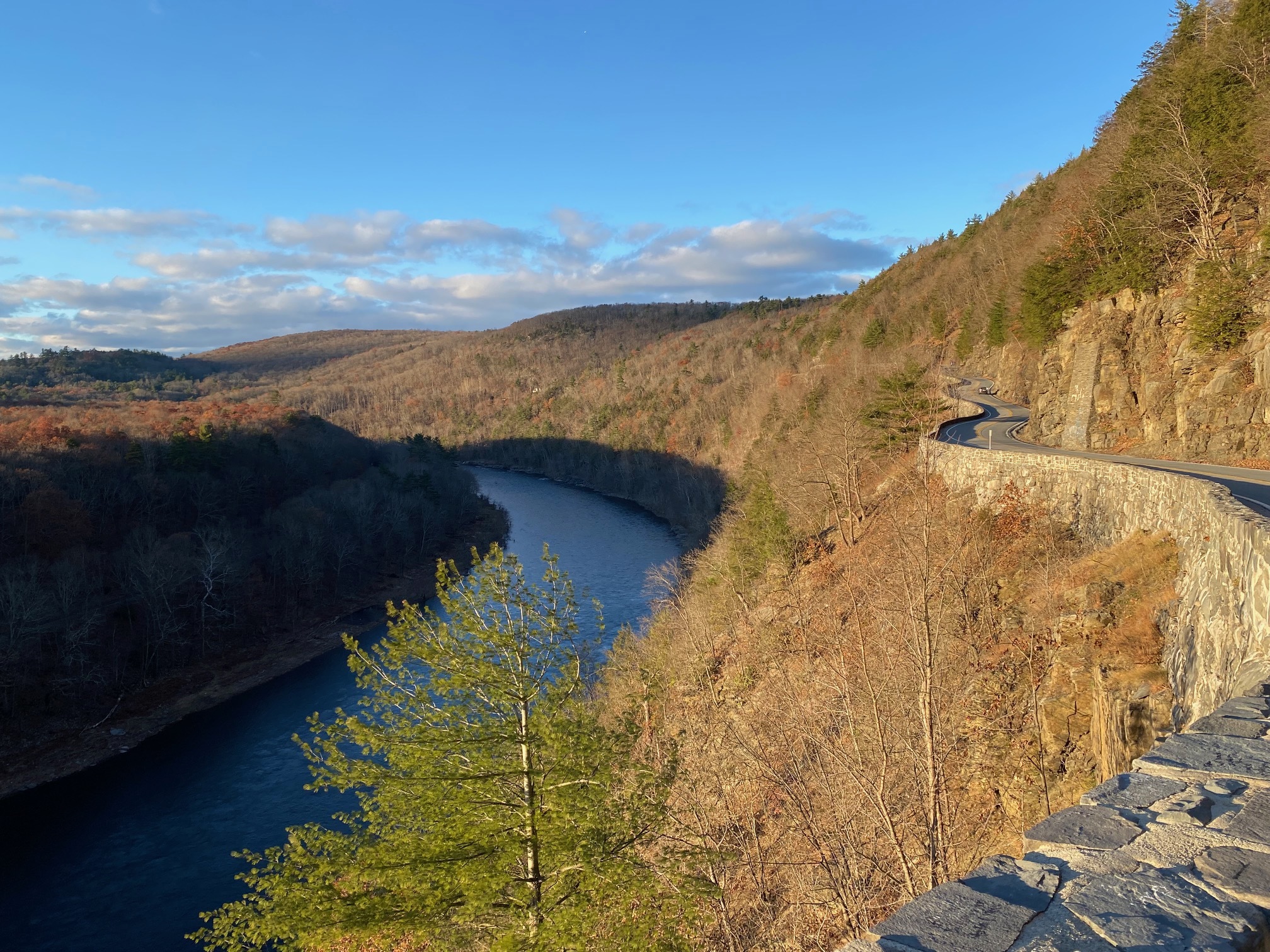
Hawks Nest is a scenic overlook located outside of Port Jervis, NY, approximately 300 feet above the Delaware River. It gets its name from the birds of prey that nest in the area. The area is well known for the winding road and is part of the Upper Delaware Scenic Byway.
The area where you are standing is composed of sedimentary rocks (which are rocks formed from pieces of pre-existing rock that was cemented together). More than 400 million years ago during the Devonian Period (416 to 57 mya), this area was an ancient sea, with several different rivers draining here and forming tidal flats. At the time, there was a mountain range called the Acadian Mountains which was being uplifted along the east coast of North America. Ancient rivers had carved out valleys and carried away the sediments and where the rivers met the sea, the currents slowed, and the sand gravel and clay were deposited. This area was known as the Catskill Delta. More layers of sediments were deposited and the pressure from the overlying rock layers caused the particles to become compacted and cemented together to form sedimentary rock. The entire formation is known as the Catskill Delta Formation and is up to 10,000 feet thick and it covers parts of eastern Pennsylvania and southern New York. The rocks visible from the overlook are predominantly shale, sandstone, and siltstone.
Sandstone is a type of sedimentary rock that is made up of sand-sized grains of mineral or rocks. The grains are typically cemented together with silica, calcium carbonate, or iron oxide. Sandstone can vary in color from white to red to gray, the color depends on the type of minerals that are present. In this region, sandstone was formed from sand that was deposited in ancient river systems and shallow seas. Another type of rock is siltstone, which is made up of silt-sized particles. Silt is finer than sand, but coarser than clay. Like sandstone, siltstone can be cemented together with a variety of minerals, and the colors can vary from gray to brown to red. Siltstone is often found in layers that alternate with layers of sandstone and shale. Lastly there is shale which is made up of clay-sized particles. It is usually a gray or black color, and is split into thin layers. Shale is often found in layers that are sandwiched between layers of sandstone or siltstone. Shale is formed from mud that was deposited in quiet, low energy environments like swamps or the bottom of shallow lakes. These rocks are important because they can tell us about the ancient environments in which they were formed. For example sandstone and siltstone can suggest that an area was once covered by a shallow sea or delta, while the presence of shale suggests the area was once a swampy lowland.
The Delaware River and surrounding valleys were formed by a combination of erosion, tectonic activity, and glaciation. The river itself is the result of erosion by ancient rivers and streams that flowed through the area, which carved out the deep valley you see in front of you. Tectonic activity, such as the collision of tectonic plates, also played a role in the formation of the valley. Evidence of tectonic activity can be seen within the rocks in the area. These rocks have been exposed to intense pressure from tectonic activity and this has caused them to fold and fracture (known as faults). These folds and fractures can provide geologic clues on the forces that shaped the landscape in front of you. Another geologic feature is jointing, which refers to the natural cracks that form in rocks as they cool and contract. You might not think much of them, but they can influence the way that the rock weathers and erodes over time. Minerals within the rocks also can provide vital information. Common minerals found within rocks in the area include iron oxide (rust color), calcite (usually white), and pyrite (fool's gold appearance). These minerals can give the rock distinct colors and textures. It is also worth mentioning cleavage, which refers to the tendency of rocks to break along planes (or zones) of weakness. This can create a distinctive pattern of flat surfaces in the rock, which can be seen at the Hawk's Nest Overlook. The last feature I want to mention are concretions. Concretions are rounded masses of mineral matter that can form within sedimentary rocks. They are oval or spherical in shape and are usually harder and more resistant to weathering than the host rock. They form inside sediments before they harden into rock, and while the sediments are still soft and are formed when the minerals within sediments precipitate around a nucleus such as a pebble.
All observations can be safely made from the overlook. Please stay out of the road.
Logging Requirements:
- What type of rock makes up the cliffs visible from the Hawk's Nest Overlook? What does this tell us about the depositional environment?
- How do geologists distinguish between faults and joints in rocks? Can you identify any fault or joints and if so, does there appear to be a pattern to their spacing or is it random? What features can be used to distinguish between them?
- Can you identify any minerals with cleavage in the rocks at the Hawk's Nest Overlook? How does cleavage affect the appearance and properties of the rock?
- What are concretions and how are they formed? Do you see any concretions within the rocks? What do they look like, and how do they differ from the surrounding rock?
- Upload a photo with the Delaware River in the background, taken at the overlook at Hawk's Nest.