
Come si forma il granito?
Il granito è una delle rocce più abbondanti sulla superficie terrestre; si tratta di una roccia ignea intrusiva formata per la maggior parte da feldspati, quarzo e miche. L’origine del granito è stata per molti decenni fonte di controversie e accese discussioni. L’ipotesi attualmente più diffusa è quella della genesi per cristallizzazione frazionata. La cristallizzazione frazionata è una graduale separazione dei minerali cristallizzati dal magma. Un’ulteriore ipotesi è quella della genesi per estremo metamorfismo. Il granito è una roccia ignea intrusiva, si è quindi formato a seguito della lenta solidificazione di un magma che si è intruso a profondità comprese tra 1,5 e 50 km. Quando il magma della crosta inferiore o del mantello litosferico invade i livelli crostali superiori, a circa cinque-dieci chilometri sotto la superficie, vi si forma spesso una camera magmatica. In questo, il magma si solidifica lentamente in granito. Ai bordi del cosiddetto plutone, il blocco è ben visibile per la grande presenza di xenoliti.
Cos'è uno xenolito?
Uno xenolito ("roccia straniera") è un frammento di roccia che viene avvolto in una roccia più grande durante lo sviluppo e la solidificazione di quest'ultima. In geologia , il termine xenolito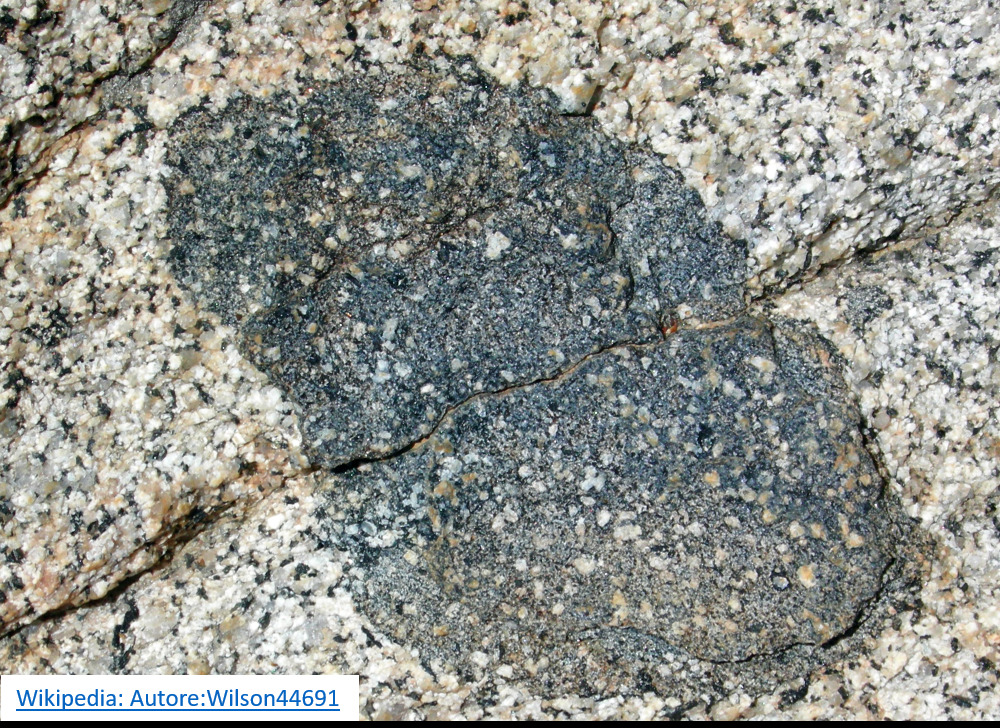 è usato quasi esclusivamente per descrivere le inclusioni nella roccia ignea trascinate durante l' ascesa, la collocazione e l'eruzione del magma.Gli xenoliti possono essere inghiottiti lungo i margini di una camera magmatica , strappati dalle pareti di un condotto lavico in eruzione o diatremi esplosivi o raccolti lungo la base di un corpo di lava che scorre sulla superficie terrestre. Per essere considerata un vero xenolito, la roccia inclusa deve essere identificabilmente diversa dalla roccia in cui è avvolta; una roccia inclusa di tipo simile è chiamata autolite o inclusione affine. Gli xenoliti e gli xenocristalli forniscono importanti informazioni sulla composizione del mantello altrimenti inaccessibile.
Cos'è un autolite?
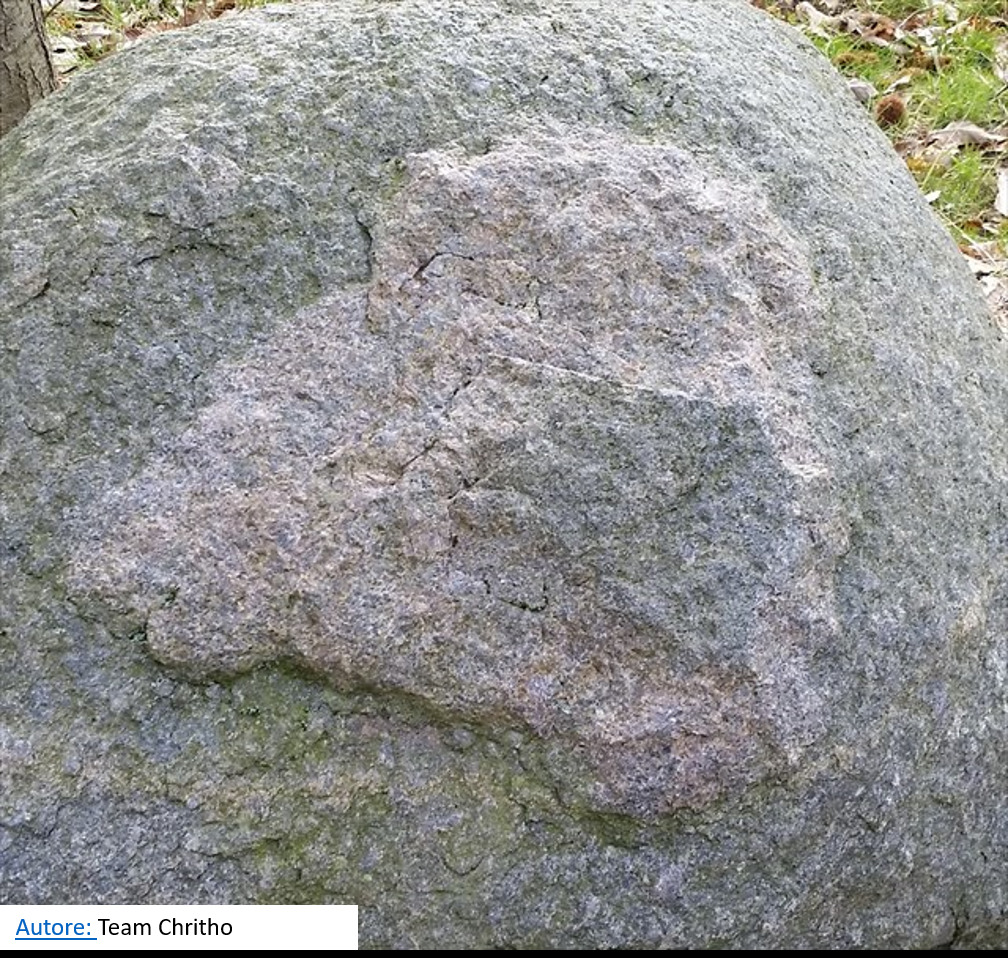 Frammento di roccia che è stato avvolto da una roccia più grande di tipo simile, durante lo sviluppo e l'indurimento di quest'ultima. E un frammento di una porzione di roccia precedentemente cristallizzata racchiusa in materiale dello stesso magma che si è poi solidificato. Gli autoliti sono quindi inclusioni di frammenti di fuso più vecchio solidificato in un fuso più giovane, entrambi originati dallo stesso magma madre.
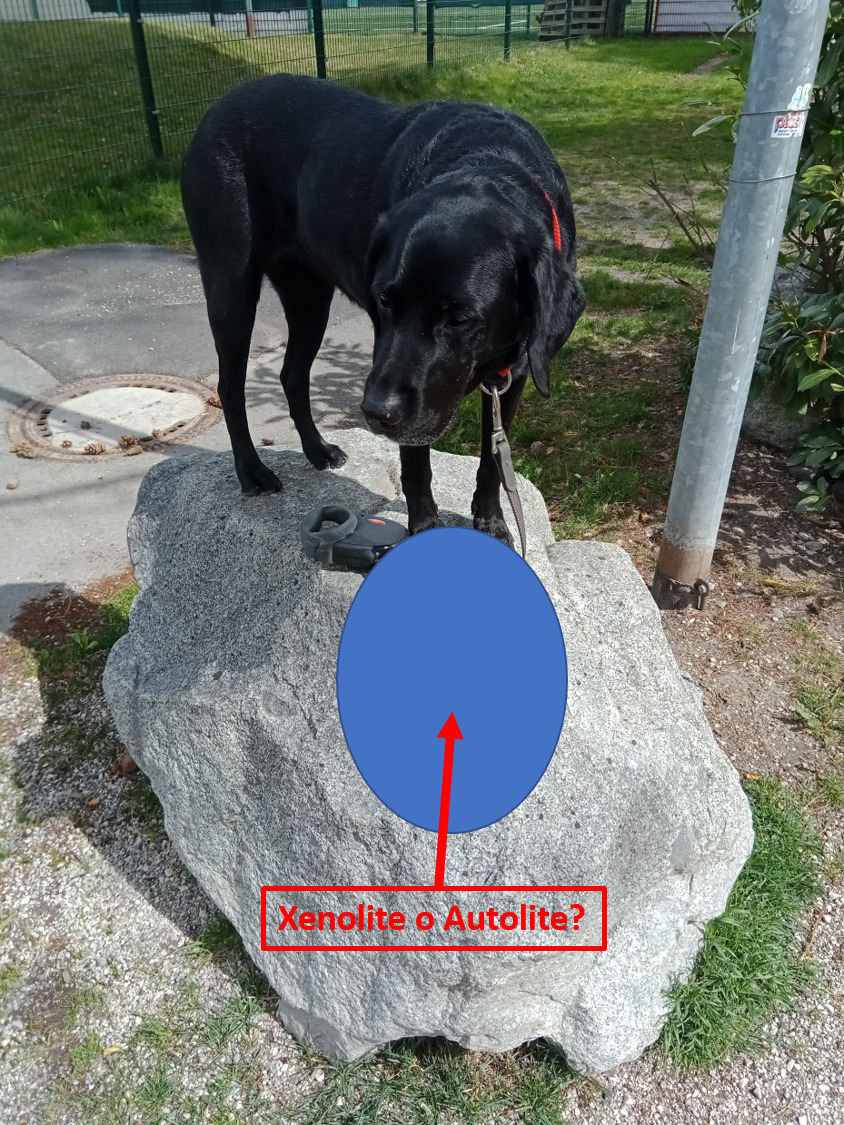
Per loggare questa Earthcache, andate alle coordinate indicate e rispondete alle seguenti domande. Inoltre, dovrete pubblicare con il log una vostra foto sul posto. Ovviamente, se non si vuole apparire nella foto, un oggetto personale è una prova sufficiente della vostra presenza. (Secondo le linee guida delle Earthcache, è possibile richiedereil fotolog dal giugno 2019.)
1.) Xenolito è più vecchio o più giovane del granito?
2.) Dai un'occhiata da vicino alla mostra e confronta le inclusioni con le spiegazioni nell'elenco. Questo è uno xenolito o un autolito? - Giustifica la tua decisione.
3.) I bordi dell'inclusione sono ben definiti o è una transizione graduale?
Puoi loggare immediatamente. Se qualcosa non è corretto, ti contatterò.

Wie entsteht Granit?
Granit ist eines der am häufigsten vorkommenden Gesteine auf der Erdoberfläche. Es ist ein aufsteigendes magmatisches Gestein, das hauptsächlich aus Feldspat, Quarz und Glimmer besteht. Die Herkunft von Granit ist seit vielen Jahrzehnten eine Quelle von Kontroversen und hitzigen Diskussionen. Die derzeit am weitesten verbreitete Hypothese ist die der Entstehung durch fraktionierte Kristallisation. Die fraktionierte Kristallisation ist eine sukzessive Abtrennung von auskristallisierten Mineralen aus einem Magma. Eine weitere Hypothese ist die der Genese durch extreme Metamorphose. Er entstand als Ergebnis der langsamen Erstarrung eines Magmas, das in Tiefen zwischen 1,5 und 50 km eindrang. In dem langen Erstarrungs- und Umwandlungsprozess haben sich die mineralischen Verunreinigungen in Form von Granulat bewegt und rekristallisiert. Durch diesen Prozess ist ein besonders widerstandsfähiger Hartstoff entstanden, der auch viele ästhetische Ansprüche zu erfüllen vermag. Wenn Magma aus der unteren Erdkruste oder dem lithosphärischen Mantel in höhere Krustenniveaus eindringt, etwa fünf bis zehn Kilometer unter der Erdoberfläche, entsteht dort oft eine Magmakammer. In dieser erstarrt das Magma langsam zu Granit. An den Rändern des sogenannten Pluton ist die Verstopfung aufgrund der großen Präsenz von Xenolithen deutlich erkennbar.
Was ist ein Xenolith?
Ein Xenolith ("Fremdgestein") ist ein Gesteinsbrocken, der bei seiner Entstehung und Verfestigung von einem größeren Gestein umhüllt wird. In der Geologie wird der Begriff Xenolith fast ausschließlich verwendet, um die beim Aufstieg, Ort und Ausbruch von Magma mitgeschleppten Einschlüsse im Eruptivgestein zu beschreiben. Xenolithe können entlang der Ränder einer Magmakammer verschluckt, von den Wänden einer ausbrechenden Lavaröhre oder von explosiven Vulkanschloten gerissen oder entlang der Basis eines Lavakörpers gesammelt werden, der auf der Erdoberfläche fließt. Um als echter Xenolith betrachtet zu werden, muss das enthaltene Gestein identifizierbar sein und sich von dem Gestein unterscheiden, in das es eingehüllt ist. Ein eingebettetes Gestein eines ähnlichen Typs wird als Autolith oder verwandter Einschluss bezeichnet. Xenolithe und Xenokristalle liefern wichtige Informationen über die Zusammensetzung des ansonsten unzugänglichen Mantels.
Was ist ein Autolith?
Ein Gesteinsfragment, das von einem größeren Gestein ähnlicher Art während der Entstehung und Erhärtung des letzteren umhüllt wurde. Es ist ein Fragment eines Teils von zuvor kristallisiertem Gestein, eingeschlossen in Material desselben Magmas, das dann erstarrte. Autolithe sind also Einschlüsse von Bruchstücken erstarrter älterer Schmelze in einer jüngeren Schmelze, wobei aber beide vom gleichen Muttermagma abstammen.
Um diesen Earthcache zu loggen, begib dich zu dieser Location und beantworte nachfolgende Fragen. Anschließend postet zu eurem Log bitte noch ein Foto von euch an der Location. Wenn ihr selbst nicht auf dem Foto erscheinen wollt, reicht natürlich auch ein persönlicher Gegenstand auf dem Foto als Beweis eurer Anwesenheit. (Laut Earthcache Guidelines ist die Forderung eines Fotobeweises seit Juni 2019 wieder erlaubt.)
1.) Ist Xenolith älter oder jünger als Granit?
2.) Schaut euch das Exponat genau an und vergleicht die Einschlüsse mit Erklärungen im Listing. Handelt es sich hier um einen Xenolith oder u einen Autolith? - Begründet eure Entscheidung.
3.) Sind die Ränder des Einschlusses scharf abgegrenzt oder ist es ein fließender Übergang?
Danach könnt Ihr sofort loggen. Wenn irgendetwas nicht in Ordnung sein sollte, melde ich mich.

How is granite formed?
Granite is one of the most abundant rocks on the earth's surface; it is an intrusive igneous rock made up mostly of feldspar, quartz and micas. The origin of granite has been a source of controversy and heated discussions for many decades. The currently most widespread hypothesis is that of the genesis by fractional crystallization. Fractional crystallization is a gradual separation of crystallized minerals from magma. A further hypothesis is that of the genesis by extreme metamorphism. The granite is an intrusive igneous rock, it was therefore formed as a result of the slow solidification of a magma that intruded at depths between 1.5 and 50 km. When magma from the lower crust or lithospheric mantle invades higher crustal levels, about five to ten kilometers below the surface, a magma chamber often forms there. In this, the magma slowly solidifies into granite. At the edges of the so-called pluton, the blockage is clearly visible due to the large presence of xenoliths.
What is a Xenolith?
A xenolith ("foreign rock") is a rock fragment that becomes enveloped in a larger rock during the latter's development and solidification. In geology, the term xenolith is almost exclusively used to describe inclusions in igneous rock entrained during magma ascent, emplacement and eruption. Xenoliths may be engulfed along the margins of a magma chamber, torn loose from the walls of an erupting lava conduit or explosive diatreme or picked up along the base of a flowing body of lava on the Earth's surface. To be considered a true xenolith, the included rock must be identifiably different from the rock in which it is enveloped; an included rock of similar type is called an autolith or a cognate inclusion. Xenoliths and xenocrysts provide important information about the composition of the otherwise inaccessible mantle.
What is an autolith?
A rock fragment that was enveloped by a larger rock of a similar type, during the development and hardening of the latter. It is a fragment of a portion of previously crystallized rock enclosed in material of the same magma which then solidified. Autoliths are therefore inclusions of fragments of solidified older melt in a younger melt, both originating from the same mother magma.
To log this Earthcache, go to this location and answer the following questions. Then post a photo of you at the location to your log. Of course, if you do not want to appear in the photo, a personal item in the photo is enough proof of your presence. (According to the Earthcache Guidelines, photo-proofing has been required since June 2019.)
1.) Is Xenolith older or jounger than granite?
2.) Take a close look at the exhibit and compare the inclusions with explanations in the listing. Is this a Xenolith or an Autolith? - Justify your decision.
3.) Are the edges of the inclusion sharply defined or is it a smooth transition?
After that you can give your log directly. If anything is not ok, i will contact you.
l'indice delle fonti:
· Wikipedia
· Fotos intrinsecamente