M3A1 Stuart Tank
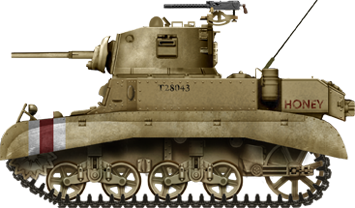
The M3A1 Stuart Tank, the official British designation was “Stuart”, paying homage to Civil War Confederate general J.E.B. Stuart, they found themselves affectuously dubbed “Honey”, because of their smooth ride. But this nickname never stuck with the US Military. Despite of this, all following tanks provided to the British received a Secession War general name and the tradition stuck up to 1945, finally being adopted by the US army itself. They served extensively in WWII in Northern Africa, where they popular for their speed, sturdiness and reliability.
Development
The American light tank design prior to World War II, the M2 light tank, was seen as obsolete after observing Germany's Panzer forces tear through Europe. The design was to be upgraded with more armor, a better suspension, and a new gun recoil system. The revised version was designated the Light Tank M3, and given the name "General Stuart" by the British, which becomes part of the name. At its basis, the light tank had a 37 mm cannon with a similar layout as the M2 light tank, with the radial engine at the rear and the transmission on the front, though the radial engine was in high demand so the Guiberson diesel T-1210 were fitted in some models to substitute the engine. The design used the VVSS bogie system seen on previous American tank designs. The tank had a crew of four: driver, assistant driver, gunner, and commander, who doubled as the loader.
The first variant of the M3 Stuart light tank was very similar to the M2 light tanks. It had five machine gun armaments scattered around like the M2, but featured better armor and a better cannon with the 37 mm M6 cannon. The design did not have a turret basket for the crew and it was constructed out of rivets, which increased the chance of spalling in the tank. Nevertheless, the first variant M3 saw about 5,811 units produced. The second variant, the Light Tank M3A1 Stuart, featured a new turret with no cupola on it, plus an added gun stabilizer. The machine guns on the hull sides were removed, so now the total machine guns was reduced from five to three. The design also featured a welded armor design to remove the weakness of riveted armor. 4,621 of this variant was produced from May 1942 to February 1943. The most used variant, the Light Tank M5A1 Stuart, had a completely redesigned hull and turret, with the hull most notably having a full sloping frontal armor than the previous designs. This variant had about 6,810 units produced. All in all, the Stuart light tank design and its variants were produced in massive quantities from March 1941 to October 1943 with a total of 25,000 units produced.
Combat Usage
The British were the first to use the M3 Stuart in Africa in 1941, using it in Operation Crusader. However, the result ended with heavy losses, due to the better training the German Afrika Korps had compared to the British tank doctrine. The encounter also pointed out many flaws in the Stuart, mainly the cramped interior and limited operational range, but was praised for its high mobility and reliability when compared to the British contemporary designs. In 1942, the Stuarts were generally kept as recon units rather than combat units, and some were even modified to improve speed and range by removing the turret, and others were converted to armored personnel carriers and command vehicles. Though the British used it extensively, it was still in small proportion compared to the American usage. The Soviet Union was also another user of the Stuart tanks, but found it unfavorable due to their own logistics, plus it was not made to withstand the Russian Rasputitsa or even the winter. The Soviet eventually turned down any more offers for the Stuart by 1943. The Stuarts also supported the British and Chinese forces in Asia against the Japanese Army, and also France and Yugoslavia in Europe against the German Wehrmacht.
The Americans used it widely in both operational theaters. In the Pacific, the Stuarts were the first tanks America used in a tank vs. tank operation against the Imperial Japanese Army, where five M3s fought Type 95 Ha-Gos in the Phillippines. Though the Stuarts were newer than the Japanese tank designs by about five years, they were seen as equal in performance and firepower, but the Stuart benefited by the support of the American industry arm. The Stuarts served in the Pacific slightly better than its heavier counterparts such as the M4 Shermans due to its lighter weight and maneuverability in the poor jungle terrain, but the Stuarts in the Pacific were gradually replaced by Shermans due to heavy losses from its thinner armor. The M3 Stuarts were also some of the first US tanks to be converted into flamethrower tanks, named as the "Satan". The Satan tanks provided favorable results to the concept of a flamethrower tank, and were replaced by flamethrower-equipped M4 Shermans in 1945.
In Europe, the Stuarts formed a large part of the American tank battalions, though following the British path by sidelining the Stuarts from combat duties after heavy losses and to serve alongside Shermans as scouting units. A typical tank battalion for the US Army consisted of three companies of Shermans and one of Stuarts. The Stuarts, other than scouting, were also used in cavalry roles and infantry support since their cannon are unable to compete with the German tank designs. Despite their dwindling capabilities in battle, the Stuart was kept in service up until the end of the war due to the large production numbers.
After World War II, the Stuarts were given out as cheap surplus, countries such as China, India, and Pakistan picked up a few and used them in their conflicts. Portuguese also picked up a few Stuarts for the war in Angola, and the South African Corps continued using the Stuarts until 1955, where some were still kept in service until 1968 due to available parts. Today, Paraguay is still a user of the Stuart light tanks, though as the only tracked armor used in the country.
The Stuart light tank design was also quite versatile that it was made into different variants for different roles on the battlefield. It served as a infantry support vehicle as the 75mm GMC M8 and experiments were also taken to see if it could be adapted to an anti-aircraft gun and a flamethrower as well. However, the Stuarts were becoming an aging design with inferior armor, cramped interior layout, and a small 37 mm gun, so a program to replace the light tank began in 1943 and became the M24 Chaffee, which would eventually replace the Stuarts mostly after World War II.
Rand Light Infantry
Vincit qui patitur (He conquers who endures) is the motto of the Rand Light Infantry
Rand light infantry owes its origin to the revival of the volunteer movement in South Africa in 1902. After the South African War (1899-1902), the departing of the British troops emphasised the need for the formation of volunteer regiments to safeguard the government, which was faced with a growing native problem and possibilities of revolt and rebellion from Afrikaner burghers.
The Volunteer Ordinance of 1902 provided for the formation of various regiments in Johannesburg, one of which was the Transvaal Scottish Volunteer Regiment. Henry Alvan Woolf, a member of the Regiment’s ‘F’ Company, which was the cyclist section, was instrumental in forming a new regiment, the Transvaal Cycle Corps, which was established on 1 October 1905. Previous to this, cycle companies were attached to infantry regiments mainly to provide dispatch riders. The Transvaal Cycle Corps thus had the distinction of being the first separate cycle fighting unit. 26 men of the Transvaal Cycle Corps, together with men of the Transvaal Light Infantry, formed one of the companies of the Transvaal Volunteers which took part in the successful suppression of the Bambata Rebellion in Zululand (KwaZulu-Natal) in 1906.
In 1908, the unit recognised the possibilities of mechanisation and members of the Regiment manufactured three armoured cars fitted with machine guns, creating a motorised fighting unit. This led to the renaming of the unit in 1909 to the Transvaal Cycle and Motor Corps (TC&MC).
In 1912, the volunteer movement in South Africa ended with the promulgation of a new Defence Act. In 1913, the regiment was reorganised under the Defence Act and began to function as an Active Citizen Force unit of the Union Defence Force under its new name, Rand Light Infantry, from the 1 July 1913. Simultaneously, the unit was converted to a normal infantry regiment, all cycles were disbanded and the Regiment's Pretoria detachment was transferred to the 12th Infantry (Pretoria Regiment). Interestingly, Rand Light Infantry was officially known as 11 Infantry Regiment, from its order of seniority among the Active Citizen Force regiments, until 1932 when the numerical title was dropped.
January 1914 saw RLI and other regiments mobilized to restore order and guard government property and key points during an industrial strike on the Reef. The regiment was again mobilised following the outbreak of the First World War on the 4 August 1914. The German Imperial colony of South West Africa bordered immediately on South Africa and the seizing of the enemy’s bases at Luderitzbucht and Swakopmund and destroying their means of communications was viewed as essential to deny the German fleet the advantage of friendly bases on the flank of their ocean line of communication with the east. The South West Africa campaign was the only land campaign undertaken, planned and brought to a conclusion by the military forces of any Dominion of the British Empire on its own responsibility in the First World War. Although the campaign was devoid of great battles, it was characterised by great physical difficulties and arduous feats of marching in which the RLI played a distinguished role. Following the surrender of the German forces in South West Africa on the 8 July 1915, the Regiment returned to South Africa and was demobilised. As the Defence Act made it impossible for Active Citizen Force units to be mobilized for service in the war overseas, volunteers were called for the units of three brigades. The RLI supplied a full company for 3 South African Infantry which saw service in France with 1 South Africa Infantry Brigade, and also a company for 7 South Africa Infantry which went to German East Africa with 2 Brigade. Many members also joined other units.
The RLI was mobilized to restore order during the Rand mining strike (Rand Revolt) from the 09-17 March 1922, which was the most serious South African disturbance since the South African War. The revolution was a week of the grimmest sort of fighting which troops can be called upon to engage in – fighting against their own kith and kin, which demanded the highest order of discipline and duty. The conduct of RLI was most praiseworthy
The RLI was mobilized for World War II in June 1940 and gained fame in North Africa where it took part in many front-line engagements and earned battle honours at Bardia, Gazala and El Alamein. Early in 1940, a second battalion was formed, but it never fought as a unit. Its personnel were sent to the Middle East in October 1941 as reinforcements for units of the 1st South African Division, and the battalion was disbanded on its date of sailing.
The 1st Battalion RLI was brigaded with the Royal Durban Light Infantry and the Imperial Light Horse in the 3rd Infantry Brigade. It landed in Egypt on 21 June 1941. Attached to the 2nd South African Division, the Rand Light Infantry first saw action at the abortive assault on Bardia on 16 December. It was again in action at the successful capture of the town between 31 December 1941 and 2 January 1942.
The 3rd Infantry Brigade, now under the 1st South African Division, moved to the Gazala Line in April 1942. It participated in the defence of the Line, and when the Line was abandoned on 14 June, the 3rd Brigade retired to the El Alamein Box. There, at the beginning of July, enemy assaults were successfully held off. The Rand Light Infantry did not play as prominent a part in blunting the enemy advance as did other units of the Brigade, but was subjected to heavy artillery and air attack. On 23 October 1942, the Rand Light Infantry was in the forefront of the South African assault on Miteiriya Ridge, which opened the battle of El Alamein.
After the defeat of Rommel’s Afrika Korps, the RLI returned to South Africa. The Regiment was merged with the Duke of Edinburgh’s Own Rifles on 12 August 1943, and in March 1945 the combined unit absorbed the 1st Transvaal Scottish. The remaining members of the Regiment were trained in armour, and were sent as reinforcements to the South African 6th Armoured Division in Italy, but arrived too late to see action.
The RLI played a significant role during the South African Border War from 1966 to 1989 where it took part in many operations along the border of SWA / Angola. Since 1994, the RLI has continued to provide forces for internal deployment aimed at enhancing domestic security and external deployment in support of United Nations Peace Keeping Missions in Africa.
An additional snippet from Bruce TP: The RLI building originates from the boer war and was the last outpost before the open road to Pretoria. (Jan Smuts Avenue used to be called Old Pretoria Road.)
The Cache
To determine the location of the cache, have a careful look at the eight large slotted bolts on the Honey's nose. You need to complete the bolt sequence. Determine the hours each bolt indicates and write them down as smallest/largest. If the time lies in between hours, round up to the next hour.
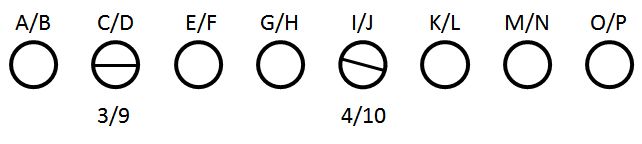
Z = the number of weapons on display in the yard, excluding the tank
Cache is located at the following coordinates:-
SOUTH 26 0L.(N-F)AO EAST 028 0K.(H-B)(P-C)(E-K)
There is security about, so make sure you are not being watched.