 Geology
Hundreds of millions of years ago, the regional landscape would have been a broad coastal plain. The coastline regularly moved across the area and back again as the sea level rose and fell. Each time the sea level lowered again, the shallow sea floor exposed by the retreating coastline was reclaimed by rivers and colonised by dense vegetation. Thick accumulations of plant matter were buried beneath further layers of sediment when the sea levels rose again. Continual subsidence enabled the plain to accumulate a substantial thickness of sedimentary layers, until it was eventually inverted and gently deformed by folding and faulting, bringing the deep layers closer to the surface.
The Fossilised Tree
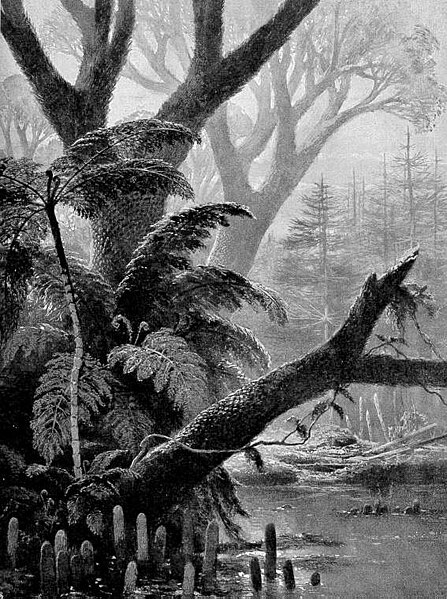
The stump you see before you grew around 300 million years ago. It was a Giant Club Moss or Lycopod, and grew tens of metres tall. For much of the time the trunk was just a straight pole with leaves attached. In maturity, it produced a crown of branches with cones. When it died, it was covered by other dead plants and eventually a layer of sediment when the sea level rose again. The tree lay undisturbed for hundreds of millions of years until builders uncovered it while excavating for the foundations of Sheffield Station in the 1860s. It was displayed in High Hazel's park in Darnall, before being brought to the Botanical Gardens.
The Botanical Gardens
In 1833 the Sheffield Botanical and Horticultural Society was formed to promote both healthy recreation and self-education, through the development of a botanical garden. A period of fundraising followed and the land was purchased. In 1834, the Society appointed Robert Marnock, gardener of Bretton Hall, Wakefield (now the Yorkshire Sculpture Park), to design the Gardens and act as their first Curator. He laid out the Gardens in the then highly fashionable Gardenesque style, where each plant was displayed to perfection in scattered plantings. The Gardens were finally opened in June 1836, when more than 12,000 people visited in the first two weeks. The Gardens were only open to the general public on four Gala days per year; otherwise admission was limited to shareholders and annual subscribers.

Logging Your Find
In order to log your find, please send a message answering the following questions. You may need to do some research to answer these questions, the answers to which are freely available on the internet.
- Describe how the stump looks and feels. If you think there are different colours or textures please describe them.
- What type of rock (Igneous, Sedimetary or Metamorphic) has the stump become?
- Why do you think only the stump and roots remain, and not the rest of the tree?
In addition, optionally upload a picture of yourself or your GPS with the stump or around the Botanical Gardens. You can log your find immediately, but please send the answers within 24 hours. Once I have received your message I will respond as soon as I can. If I don't reply, I may not have received your email, so please resend it. Logs where incorrect or incomplete answers have been given, or where an email has not been received, may be deleted.
I hope you enjoy the cache! As always, any feedback is greatly appreciated!